
Picture this scenario: A customer places an order on your e-commerce site at 2 PM. In most organisations, that single transaction triggers a cascade of delays. The order system records the purchase, but inventory updates wait for the overnight batch run. Customer service sees outdated stock levels until morning. By the time all systems finally synchronise, your customer may have already rung support wondering why their order seems delayed.
These architectural limitations become competitive disadvantages when customers expect instant confirmations and immediate responsiveness.
Event-driven architecture offers a fundamentally different approach, one designed for businesses that need to act on information as it happens rather than waiting for the next batch process to complete.
Why Traditional Integration Creates Business Problems
Most enterprises still rely on integration patterns designed for a slower, more predictable world. Even with modern APIs and cloud platforms, many organisations continue using architectures that batch process data, schedule synchronisation for off-peak hours, and require manual intervention when problems occur.
These approaches worked adequately when business moved at the speed of quarterly reports and monthly reconciliations. They become competitive disadvantages when customers expect instant confirmations, real-time personalisation, and immediate problem resolution.
The Reactive Integration Problem
Even sophisticated organisations using REST APIs often fall into polling patterns that create systematic delays. Your CRM checks for new leads every 15 minutes. Inventory systems query e-commerce platforms hourly for stock updates. Customer service platforms pull ticket updates every few minutes.
This approach remains fundamentally reactive rather than responsive—systems constantly ask “has anything changed?” instead of being notified when changes actually occur. The business impact compounds: sales representatives work with outdated lead data, customer service agents see stale inventory levels, and marketing campaigns run against old customer information.
When these integrations fail—whether through API timeouts, rate limiting, or data format changes—someone has to notice, diagnose the problem, and manually restart operations. These failures often remain invisible until the impact becomes severe, creating customer friction and operational overhead.
How Event-Driven Architecture Changes Business Operations
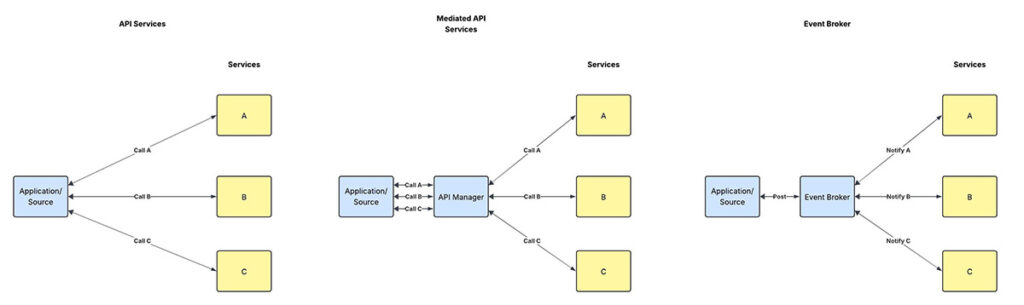
Event-driven architecture reframes system communication entirely. Instead of applications directly calling each other or waiting for scheduled synchronisation, systems communicate by publishing and consuming events—notifications that something significant has happened.
This shift from request-response to publish-subscribe patterns eliminates many traditional integration problems while enabling new business capabilities that weren’t practically possible before.
Immediate Response to Business Events
In an event-driven system, when that customer places their 2 PM order, the transaction immediately publishes an “order created” event. Inventory systems instantly reserve the items. Fulfilment centres begin processing immediately. Customer service sees the order status in real-time. Marketing systems update availability within seconds.
The customer receives immediate confirmation with accurate delivery estimates. The entire organisation operates with consistent, up-to-date information within seconds rather than hours. This enables business operations that were previously impractical—real-time personalisation, dynamic pricing that responds to actual demand, and proactive customer service.
Loosely Coupled System Evolution
Event-driven architectures connect systems through events rather than direct integration, fundamentally changing how businesses can evolve their technology capabilities. You can modify, replace, or add new systems without disrupting existing operations.
Need to integrate a new payment processor? Simply configure it to consume order events and publish payment events. Want to add predictive analytics? Create a new service that consumes relevant events and publishes insights. Existing systems continue operating unchanged while the business gains new capabilities.
This architectural flexibility translates directly into business agility. New market opportunities can be addressed quickly because the underlying systems adapt easily. Compliance requirements can be implemented by adding new event consumers rather than modifying existing applications. Partnership integrations become straightforward because partners can consume your business events without complex system-to-system connections.
Self-Healing Operations Through Event Architecture
Event-driven systems can handle failures gracefully through built-in resilience patterns. If a service becomes temporarily unavailable, events queue automatically and process when the service recovers. If processing fails, the system can retry automatically or route events to alternative handlers.
This resilience reduces operational overhead dramatically whilst maintaining service quality even when individual components experience problems. We’ve seen organisations reduce integration-related incidents by 70-80% after implementing event-driven patterns properly.
More importantly, this reliability enables businesses to commit to higher service levels with confidence. When your architecture handles failures gracefully, you can offer stronger guarantees to customers and partners.
The Measurable Business Impact
The advantages of event-driven architecture extend far beyond improved system performance. They translate into quantifiable business outcomes that directly affect competitiveness, customer satisfaction, and operational efficiency.
Enhanced Customer Experience
Customers increasingly expect immediate responses and consistent experiences. Event-driven architectures enable this by ensuring information flows instantly between systems. When customers update their address, that change immediately propagates everywhere. When they make purchases, recommendations update based on their latest behaviour.
One retail client saw customer satisfaction scores increase by 23% after implementing event-driven order processing, primarily because customers received accurate, real-time updates about purchases and deliveries.
Operational Agility for Competitive Advantage
Event-driven architectures enable rapid adaptation to market conditions and competitive pressures. A financial services client implemented new fraud detection rules in days rather than months because adding new event processors didn’t require modifying existing systems.
Retail organisations can adjust pricing strategies quickly because price changes automatically flow to all relevant systems through events. Marketing campaigns can incorporate real-time behavioural data because customer interactions generate events that analytics systems consume immediately.
Real-Time Decision Making
Event-driven systems provide continuous business intelligence rather than periodic snapshots. Managers can observe trends as they develop and make decisions based on current information. One manufacturing client reduced inventory carrying costs by 18% because event-driven supply chain visibility enabled just-in-time procurement based on actual rather than projected demand.
When Event-Driven Architecture Provides Maximum Value
Event-driven approaches provide the most compelling return on investment when real-time responsiveness directly impacts business outcomes, systems need to remain loosely coupled, or business processes span multiple applications requiring coordination.
Look for scenarios where delays currently create customer friction or revenue loss, where manual intervention frequently resolves integration failures, or where multiple systems need coordinated updates for business changes. Common high-value starting points include order processing workflows, customer data synchronisation, inventory management, and fraud detection systems.
Traditional integration patterns remain appropriate for simple, low-volume data transfers, stable workflows that rarely change, or resource-constrained environments where the additional complexity isn’t justified by the business benefits.

Architecture as Competitive Strategy
In an economy where competitive advantage comes from operational excellence and immediate responsiveness, system architecture matters more than ever. Organisations that can respond immediately to events, maintain consistent information across all systems, and adapt quickly to changing requirements will systematically outperform those constrained by batch processing and tightly coupled systems.
Leading organisations are already gaining advantages through these approaches. Amazon’s recommendations update in real-time based on customer behaviour. Netflix adjusts content delivery instantly based on viewing patterns. Financial institutions detect and prevent fraud within milliseconds of suspicious transactions.
The question isn’t whether event-driven patterns will become mainstream—they already are in leading organisations. The question is whether your business will adopt these approaches proactively to gain competitive advantage, or reactively when market pressure makes traditional approaches unsustainable.
The businesses that thrive in the next decade will be those that can act on information as it happens, rather than waiting for the next batch process to complete. Event-driven architecture provides the foundation for this capability—and the choice between leading or following is yours to make.
Ready to Transform Your Integration Strategy?
Don’t let integration challenges hold your business back. At Cloudorizon, we’ve helped organisations move from fragmented, costly approaches to streamlined automation that delivers real business value.
🚀 Next Steps:
- Book a free strategy session – 30 minutes to identify your biggest wins
About Cloudorizon: We’re Workato specialists who understand that successful integration isn’t just about technology – it’s about connecting business possibilities. With 54+ enterprise clients and proven methodologies, we help organisations build integration capabilities that scale.
Questions about this article? Get in touch – we’d love to hear from you.