
Tag: Operational Efficiency

  • Preventing AI Expense Fraud: Why Integration Beats AI Detection

    Preventing AI Expense Fraud: Why Integration Beats AI Detection

    The last thing your finance team needs is another AI arms race. 

    The Financial Times recently reported on a troubling trend emerging across UK and US businesses: employees are using AI to generate fake expense receipts, and it’s working. (Note: The FT article is behind a paywall, accessible to FT subscribers only.) 

    According to data from leading expense software platforms cited in the piece, this isn’t theoretical anymore – it’s happening at scale. 

    The Numbers Are Alarming 

    • AppZen reports that fake AI receipts now account for approximately 14% of fraudulent documents submitted in September 2024 – up from precisely zero last year 
    • Fintech group Ramp flagged over $1 million in fraudulent invoices within just 90 days 
    • 30% of financial professionals surveyed by expense platform Medius have witnessed a rise in falsified receipts since OpenAI’s GPT-4o launch 

    The receipts being generated are frighteningly convincing – so convincing that human reviewers can’t spot them. The industry response has been predictable: fight AI with AI using software that scans for metadata and patterns. 

    But this is fundamentally flawed. Fraudsters can strip metadata with a simple screenshot. And you’re locked into an escalating arms race where each generation of AI becomes better at fooling detection tools. You’re spending money on technology to combat technology, with no guarantee you’ll stay ahead.

    There’s a Better Way: Make Fraud Rare and Obvious 

    The smartest approach isn’t getting better at spotting fake receipts. It’s reducing fraud opportunities dramatically and making remaining attempts obvious through intelligent integration and policy. 

    1. Enforce Corporate Card Usage (Eliminate 70-80% of Fraud Opportunity) 

    Integration makes corporate card policies enforceable and friction-free: 

    • Auto-populate expense claims directly from corporate card transactions (Amex, Mastercard, Visa) 
    • Flag personal card expenses automatically for additional scrutiny 
    • Real-time transaction matching to verify submitted expenses against actual card transactions 

    Result: Once management mandates corporate cards for standard business expenses, integration ensures compliance. The vast majority of expenses are automatically verified against actual transactions—no opportunity to submit phantom expenses. 

    2. Contextual Verification for Unavoidable Personal Expenses 

    For remaining personal card reimbursements (cash-only merchants, emergencies), integrate systems to verify context: 

    • Travel booking platforms (Concur, TravelPerk) – Confirm trips actually occurred 
    • Calendar systems (Outlook, Google) – Verify meetings at claimed locations  
    • Project management tools – Validate legitimate business purposes 
    • Pre-approval workflows – Require manager approval before expenses are incurred 

    Result: Even without transaction verification, you create multiple checkpoints that make consistent fraud nearly impossible. 

    3. Automated Vendor Verification 

    Integrate with business registries and verification databases to confirm merchants actually exist: 

    • Companies House (UK) and equivalent business registries internationally 
    • Google Places API to verify business locations and operating hours 
    • VAT number verification systems across European jurisdictions 

    Result: An AI-generated receipt for a fabricated merchant gets automatically flagged when the system confirms no such business exists at that location. 

    4. Intelligent, Risk-Based Controls 

    Integration enables tiered scrutiny based on risk: 

    • Small amounts (under £50): Low friction, post-audit sampling 
    • Medium amounts (£50-500): Contextual verification triggers automatically 
    • Large amounts (£500+): Pre-approval required, multiple verification points 

    When anomalies are detected, the system automatically holds reimbursement, routes to senior approvers, and flags patterns across integrated systems.

    Why This Beats AI Detection 

    AI Detection Policy + Integration 
    Arms race – Fraudsters adapt constantly Eliminates 70-80% of fraud opportunities via corporate cards
    Circumvented via screenshots Must fake context across 5-7 integrated systems
    Reactive – After submissionPreventative – Pre-approval and verification 
    Ongoing AI model update costsBased on actual bookings, meetings, transactions, registries

    The Bottom Line 

    AI-generated receipt fraud is costing businesses millions. But the solution isn’t an endless technological arms race. 

    The solution is to make fraud rare and obvious. 

    By integrating expense management with corporate cards, travel platforms, calendar systems, vendor registries, and approval workflows, you dramatically reduce fraud opportunities and add verification layers that make systematic fraud nearly impossible. 

    Will this catch every single fake receipt? No. But it will: 

    • Eliminate 70-80% of fraud opportunities through corporate card enforcement 
    • Make remaining attempts obvious through contextual anomalies across multiple systems 
    • Create an economically unviable risk/reward ratio for would-be fraudsters 

    Stop trying to spot increasingly sophisticated fake receipts. Start making fraud opportunities rare through intelligent policy and integration. 

    That’s not an AI problem. That’s an integration solution. 


    Ready to Transform Your Integration Strategy?

    Don’t let integration challenges hold your business back. At Cloudorizon, we’ve helped organisations move from fragmented, costly approaches to streamlined automation that delivers real business value.

    🚀 Next Steps:


    About Cloudorizon: We’re Workato specialists who understand that successful integration isn’t just about technology – it’s about connecting business possibilities. With 54+ enterprise clients and proven methodologies, we help organisations build integration capabilities that scale.

    Questions about this article? Get in touch – we’d love to hear from you.

  • Event-Driven Architecture: Transform Business Responsiveness Through Real-Time Integration

    Event-Driven Architecture: Transform Business Responsiveness Through Real-Time Integration

    Picture this scenario: A customer places an order on your e-commerce site at 2 PM. In most organisations, that single transaction triggers a cascade of delays. The order system records the purchase, but inventory updates wait for the overnight batch run. Customer service sees outdated stock levels until morning. By the time all systems finally synchronise, your customer may have already rung support wondering why their order seems delayed.

    These architectural limitations become competitive disadvantages when customers expect instant confirmations and immediate responsiveness.

    Event-driven architecture offers a fundamentally different approach, one designed for businesses that need to act on information as it happens rather than waiting for the next batch process to complete.

    Why Traditional Integration Creates Business Problems

    Most enterprises still rely on integration patterns designed for a slower, more predictable world. Even with modern APIs and cloud platforms, many organisations continue using architectures that batch process data, schedule synchronisation for off-peak hours, and require manual intervention when problems occur.

    These approaches worked adequately when business moved at the speed of quarterly reports and monthly reconciliations. They become competitive disadvantages when customers expect instant confirmations, real-time personalisation, and immediate problem resolution.

    The Reactive Integration Problem

    Even sophisticated organisations using REST APIs often fall into polling patterns that create systematic delays. Your CRM checks for new leads every 15 minutes. Inventory systems query e-commerce platforms hourly for stock updates. Customer service platforms pull ticket updates every few minutes.

    This approach remains fundamentally reactive rather than responsive—systems constantly ask “has anything changed?” instead of being notified when changes actually occur. The business impact compounds: sales representatives work with outdated lead data, customer service agents see stale inventory levels, and marketing campaigns run against old customer information.

    When these integrations fail—whether through API timeouts, rate limiting, or data format changes—someone has to notice, diagnose the problem, and manually restart operations. These failures often remain invisible until the impact becomes severe, creating customer friction and operational overhead.

    How Event-Driven Architecture Changes Business Operations

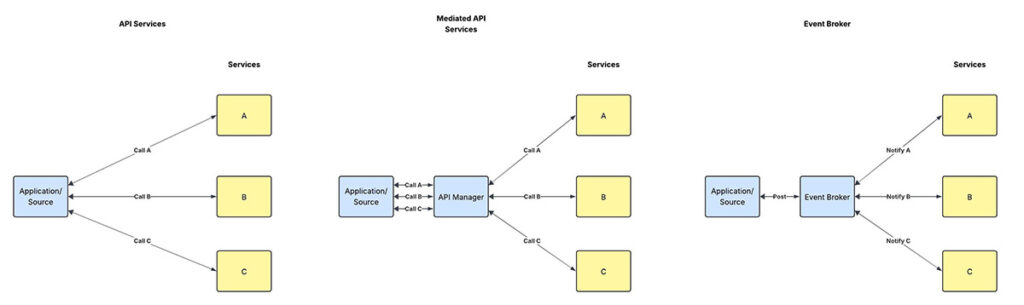
    Event-driven architecture reframes system communication entirely. Instead of applications directly calling each other or waiting for scheduled synchronisation, systems communicate by publishing and consuming events—notifications that something significant has happened.

    This shift from request-response to publish-subscribe patterns eliminates many traditional integration problems while enabling new business capabilities that weren’t practically possible before.

    Immediate Response to Business Events

    In an event-driven system, when that customer places their 2 PM order, the transaction immediately publishes an “order created” event. Inventory systems instantly reserve the items. Fulfilment centres begin processing immediately. Customer service sees the order status in real-time. Marketing systems update availability within seconds.

    The customer receives immediate confirmation with accurate delivery estimates. The entire organisation operates with consistent, up-to-date information within seconds rather than hours. This enables business operations that were previously impractical—real-time personalisation, dynamic pricing that responds to actual demand, and proactive customer service.

    Loosely Coupled System Evolution

    Event-driven architectures connect systems through events rather than direct integration, fundamentally changing how businesses can evolve their technology capabilities. You can modify, replace, or add new systems without disrupting existing operations.

    Need to integrate a new payment processor? Simply configure it to consume order events and publish payment events. Want to add predictive analytics? Create a new service that consumes relevant events and publishes insights. Existing systems continue operating unchanged while the business gains new capabilities.

    This architectural flexibility translates directly into business agility. New market opportunities can be addressed quickly because the underlying systems adapt easily. Compliance requirements can be implemented by adding new event consumers rather than modifying existing applications. Partnership integrations become straightforward because partners can consume your business events without complex system-to-system connections.

    Self-Healing Operations Through Event Architecture

    Event-driven systems can handle failures gracefully through built-in resilience patterns. If a service becomes temporarily unavailable, events queue automatically and process when the service recovers. If processing fails, the system can retry automatically or route events to alternative handlers.

    This resilience reduces operational overhead dramatically whilst maintaining service quality even when individual components experience problems. We’ve seen organisations reduce integration-related incidents by 70-80% after implementing event-driven patterns properly.

    More importantly, this reliability enables businesses to commit to higher service levels with confidence. When your architecture handles failures gracefully, you can offer stronger guarantees to customers and partners.

    The Measurable Business Impact

    The advantages of event-driven architecture extend far beyond improved system performance. They translate into quantifiable business outcomes that directly affect competitiveness, customer satisfaction, and operational efficiency.

    Enhanced Customer Experience

    Customers increasingly expect immediate responses and consistent experiences. Event-driven architectures enable this by ensuring information flows instantly between systems. When customers update their address, that change immediately propagates everywhere. When they make purchases, recommendations update based on their latest behaviour.

    One retail client saw customer satisfaction scores increase by 23% after implementing event-driven order processing, primarily because customers received accurate, real-time updates about purchases and deliveries.

    Operational Agility for Competitive Advantage

    Event-driven architectures enable rapid adaptation to market conditions and competitive pressures. A financial services client implemented new fraud detection rules in days rather than months because adding new event processors didn’t require modifying existing systems.

    Retail organisations can adjust pricing strategies quickly because price changes automatically flow to all relevant systems through events. Marketing campaigns can incorporate real-time behavioural data because customer interactions generate events that analytics systems consume immediately.

    Real-Time Decision Making

    Event-driven systems provide continuous business intelligence rather than periodic snapshots. Managers can observe trends as they develop and make decisions based on current information. One manufacturing client reduced inventory carrying costs by 18% because event-driven supply chain visibility enabled just-in-time procurement based on actual rather than projected demand.

    When Event-Driven Architecture Provides Maximum Value

    Event-driven approaches provide the most compelling return on investment when real-time responsiveness directly impacts business outcomes, systems need to remain loosely coupled, or business processes span multiple applications requiring coordination.

    Look for scenarios where delays currently create customer friction or revenue loss, where manual intervention frequently resolves integration failures, or where multiple systems need coordinated updates for business changes. Common high-value starting points include order processing workflows, customer data synchronisation, inventory management, and fraud detection systems.

    Traditional integration patterns remain appropriate for simple, low-volume data transfers, stable workflows that rarely change, or resource-constrained environments where the additional complexity isn’t justified by the business benefits.

    Architecture as Competitive Strategy

    In an economy where competitive advantage comes from operational excellence and immediate responsiveness, system architecture matters more than ever. Organisations that can respond immediately to events, maintain consistent information across all systems, and adapt quickly to changing requirements will systematically outperform those constrained by batch processing and tightly coupled systems.

    Leading organisations are already gaining advantages through these approaches. Amazon’s recommendations update in real-time based on customer behaviour. Netflix adjusts content delivery instantly based on viewing patterns. Financial institutions detect and prevent fraud within milliseconds of suspicious transactions.

    The question isn’t whether event-driven patterns will become mainstream—they already are in leading organisations. The question is whether your business will adopt these approaches proactively to gain competitive advantage, or reactively when market pressure makes traditional approaches unsustainable.

    The businesses that thrive in the next decade will be those that can act on information as it happens, rather than waiting for the next batch process to complete. Event-driven architecture provides the foundation for this capability—and the choice between leading or following is yours to make.


    Ready to Transform Your Integration Strategy?

    Don’t let integration challenges hold your business back. At Cloudorizon, we’ve helped organisations move from fragmented, costly approaches to streamlined automation that delivers real business value.

    🚀 Next Steps:


    About Cloudorizon: We’re Workato specialists who understand that successful integration isn’t just about technology – it’s about connecting business possibilities. With 54+ enterprise clients and proven methodologies, we help organisations build integration capabilities that scale.

    Questions about this article? Get in touch – we’d love to hear from you.
  • Leveraging Automation in Joiners, Movers, and Leavers (JML) Process for Enhanced Employee Experience

    Leveraging Automation in Joiners, Movers, and Leavers (JML) Process for Enhanced Employee Experience

    Lee Cunningham

    March 10, 2025 • 6 min read

    Here’s something often overlooked about employee onboarding: the first day experience of a new hire sets the tone for their long-term engagement and determines whether they’ll recommend your company to others. Yet, many organisations continue to treat the Joiners, Movers, and Leavers (JML) process with outdated methods that fail to meet today’s expectations. 

    I watched a talented developer walk out after three days at a tech firm because they couldn’t access the systems they needed to do their job. Three days of sitting around, waiting for IT tickets to be resolved. That’s not just poor process design—that’s £15,000 of recruitment costs down the drain, plus the opportunity cost of delayed project delivery. 

    The stark reality? Organisations with automated JML processes report 60% faster onboarding times and 70% fewer access-related security incidents. But here’s what really matters: their new hires actually want to stay. 

    Employee frustrated
    Traditional onboarding: when first impressions become lasting disappointments

    The Hidden Cost of Manual Mayhem 

    Traditional JML processes are organisational torture chambers disguised as standard procedure. Picture this: Sarah joins as a marketing manager on Monday. HR creates her profile. IT gets a ticket (eventually). Facilities receives a separate request for desk setup. Finance processes equipment orders. Marketing waits to brief her. 

    Each department operates in its own silo. Nobody talks to anybody else. Sarah spends her first week chasing passwords, hunting for her laptop, and wondering if she made the right career choice. 

    Meanwhile, when Tom from accounting leaves, his access to financial systems remains active for two weeks because the offboarding checklist got buried in someone’s inbox. That’s not just inefficient—it’s a security nightmare waiting to happen. I once worked with a company that only discovered an ex-employee still had a company car over a year after leaving, when a new system was implemented. 

    The fragmentation isn’t just annoying; it’s expensive. Manual JML processes typically involve 15-20 separate tasks across five departments. Every handoff is a potential failure point. Every delay compounds employee frustration. 

    Beyond Efficiency: The Real Business Impact 

    Smart organisations have discovered that JML automation isn’t just about saving time—it’s about competitive advantage. A financial services firm I worked with transformed their onboarding from a five-day marathon into a single-day sprint. The results? Their time-to-productivity for new hires dropped by 75%. 

    But the security benefits are equally compelling. Automated systems don’t forget to revoke access when someone leaves. They don’t accidentally provision administrator rights to temporary contractors. They create audit trails that compliance teams actually trust. 

    Consider the mathematics: if manual onboarding costs an average £2,500 per employee in administrative overhead, automation can reduce that to under £500. For a company hiring 200 people annually, that’s £400,000 in direct savings—before you factor in reduced turnover and faster productivity. 

    The Architecture of Seamless Transitions 

    Effective JML automation requires more than workflow software—it demands intelligent orchestration. The best systems anticipate needs rather than simply respond to requests. 

    When a new hire accepts an offer, the system should automatically trigger equipment procurement, schedule workspace setup, initiate background checks, and prepare system access based on role requirements. By day one, everything’s ready. No waiting, no chasing, no frustration. 

    For internal moves, the complexity multiplies. Access rights need careful adjustment—removing old permissions while adding new ones, ensuring continuity of critical work, updating org charts and distribution lists. Manual processes typically take 3-5 days. Automated systems can complete role transitions in hours. 

    Departures require military precision. Access must be revoked immediately upon termination notification. Equipment needs recovery scheduling. Knowledge transfer sessions require coordination. Exit interviews need booking. Miss any step, and you’ve got either security exposure or legal complications. 

    The Integration Imperative 

    Here’s where most organisations stumble: they try to automate JML in isolation. That’s backwards thinking. JML automation only works when it connects everything—HR systems, identity management, asset tracking, facilities management, even learning platforms. 

    Modern identity systems can provision user accounts automatically based on HR data. Asset management platforms can track equipment from assignment through return. Workflow engines can orchestrate complex approval chains without human intervention. 

    The key is bidirectional integration. When someone changes roles in the HR system, that change should cascade through every connected system automatically. No manual updates. No missed notifications. No inconsistent data. 

    Measuring What Matters 

    You can’t improve what you don’t measure, but most organisations track the wrong JML metrics. They count completion rates while ignoring employee satisfaction. They measure processing time while overlooking security compliance. 

    Smart metrics focus on business outcomes: time to productivity for new hires, security incident rates during transitions, employee satisfaction scores for the onboarding experience, and total cost per JML transaction. 

    One manufacturing company discovered that their automated JML system reduced security incidents by 85% while improving new hire satisfaction from 3.2 to 4.7 out of 5. Those aren’t just numbers—they represent competitive advantage in a tight talent market. 

    The Path Forward 

    Start with your biggest pain point. Usually, that’s onboarding—it’s visible, measurable, and directly impacts employee experience. Design the ideal experience first, then work backwards to the technical requirements. 

    Pilot with a specific department or role type. Sales teams often work well because their onboarding requirements are relatively standardised, and their time-to-productivity is easily measured. 

    Most importantly, involve the people who’ll use the system. IT teams building JML automation in isolation typically create technically perfect solutions that nobody wants to use. 

    The future workplace demands seamless employee experiences. Remote work, flexible arrangements, and changing expectations mean that clunky manual processes aren’t just inefficient—they’re business-limiting. 

    Organisations that master JML automation don’t just save money. They create employee experiences that become competitive advantages, security postures that enable growth, and operational efficiency that funds innovation. 

    Your next hire deserves better than waiting three days for a laptop. Your departing employees deserve better than unclear handover processes. Your organisation deserves better than manual chaos disguised as standard procedure. 

    The question isn’t whether to automate JML processes. It’s whether you’ll do it before your competitors gain the advantage. 


    Ready to Transform Your Integration Strategy?

    Don’t let integration challenges hold your business back. At Cloudorizon, we’ve helped organisations move from fragmented, costly approaches to streamlined automation that delivers real business value.

    🚀 Next Steps:


    About Cloudorizon: We’re Workato specialists who understand that successful integration isn’t just about technology – it’s about connecting business possibilities. With 54+ enterprise clients and proven methodologies, we help organisations build integration capabilities that scale.

    Questions about this article? Get in touch – we’d love to hear from you.