Stop asking AI to think and start asking it to orchestrate—before your enterprise architecture becomes ungovernable
There’s a dangerous illusion spreading through enterprise AI discussions: the belief that Large Language Models can actually think. This misconception isn’t just harmless marketing fluff—it’s leading to poor implementation decisions, unrealistic expectations, and ultimately, AI project failures that could have been avoided.
But there’s an even more insidious problem lurking beneath the surface: the “AI Wild West” that’s quietly creating architectural chaos across enterprises worldwide.
The problem isn’t with AI itself. AI is incredibly powerful and genuinely transformative when applied correctly. The problem is that we’re asking it to do the wrong things—and we’re doing it in ways that are making our enterprises ungovernable.
The “Thinking” Expectation vs. Reality
When business leaders see ChatGPT write eloquent emails or Claude explain complex concepts, it’s natural to assume these systems understand and reason like humans. The fluency is remarkable, the responses sophisticated, and the illusion complete.
Recent research from Apple reveals what AI experts have long suspected: current AI systems don’t actually think or reason—they perform what researchers call an “illusion of thinking.” The study found that Large Reasoning Models experience complete accuracy collapse when faced with truly complex problems.
This isn’t a failure of AI—it’s a misunderstanding of what AI actually does. Current AI excels at pattern recognition, statistical inference, and generating human-like responses based on training data. These are genuinely valuable capabilities, but they’re not the same as human reasoning or understanding.
The Hidden Crisis: AI Architectural Chaos
Beyond the reliability issues, there’s a more dangerous problem emerging: enterprises are inadvertently creating what enterprise architects call the “AI Wild West.”
Here’s what’s happening right now in companies around the world:
Uncontrolled Agent Proliferation: Teams creating similar AI agents independently across the organisation, each implementation using different models, prompts, data sources, and logic. No central registry or governance of what AI capabilities exist where.
The “Franken-Architecture” Nightmare: Consider this scenario playing out in real enterprises—Customer Service AI says “Premium customers get 20% discount,” Sales AI says “Premium customers get 15% discount,” and Billing AI says “Premium customers get 25% discount.” When the regulator asks “How does your system calculate customer discounts?” the answer becomes: “Well, it depends which of our 47 AI agents handles the request…”
Exponential Technical Debt: Logic duplication across agents with impossible-to-audit decision making. Each new AI agent creates exponential integration and consistency problems. No way to ensure all agents are updated consistently when business rules change.
This isn’t theoretical—it’s happening now, and it’s making enterprises ungovernable and unauditable.

The Real Cost of the Thinking Trap
When enterprises deploy AI expecting human-like reasoning, several critical problems emerge:
Overconfidence in AI decisions leads teams to trust AI for complex judgements it’s not equipped for, creating errors in critical business processes.
Inappropriate use cases follow naturally. Companies focus AI on tasks requiring genuine reasoning rather than its actual strengths, leading to disappointing performance and wasted investment.
Governance challenges emerge when you need to audit AI decisions that the system itself can’t reliably explain. When your auditor asks “Why did the AI make this decision?” and your answer is “The neural network weighted 10,000 factors in ways we can’t trace,” that’s a compliance failure waiting to happen.
Architectural chaos compounds the problem. Each team embeds different business logic in their AI implementations, creating inconsistent enterprise behaviour that’s impossible to govern centrally.
Trust erosion becomes inevitable when AI fails to meet “thinking” expectations, undermining confidence in AI technology more broadly.
The Orchestration Alternative: AI’s True Strengths
Here’s what AI genuinely excels at—and where smart companies find real value:
Natural Language Understanding makes complex systems accessible to non-technical users. AI can interpret human intent from conversational language with remarkable accuracy.
Pattern Recognition identifies which situations match which previously defined responses or workflows. AI processes context and intent to make sophisticated matching decisions.
Coordination and Orchestration manages complex, multi-step processes by selecting and executing appropriate workflows based on context. This delivers real productivity gains by making existing processes dramatically more accessible.
Information Synthesis pulls together information from multiple sources and presents it in useful formats, organising data according to established patterns.
Companies like Workato have found success by asking AI to orchestrate rather than think—whilst simultaneously solving the enterprise architecture nightmare.
How Workato Sidesteps Both the Thinking Trap and Architectural Chaos
Workato’s approach demonstrates practical AI implementation that prevents architectural chaos. Their “Genies” don’t pretend to reason from first principles—that is, they don’t start with basic facts and think through problems step by step like humans do. Instead, they implement a pattern that prevents AI chaos:
The Architectural Pattern: User Request → Genie (AI Understanding) → Workato Recipe (Business Logic) → System Actions
This separation is brilliant because AI does what it’s good at (understanding natural language and selecting appropriate workflows), business logic stays auditable (critical business rules live in Workato recipes, not in AI prompts), and enterprise governance works (all AI agents built through the same platform with consistent patterns).
Centralised AI Governance: Agent Studio provides a unified platform for building and managing all AI agents. Agent Hub creates workflows and manages agent orchestration centrally. All agents built on the same platform with consistent patterns and governance.
Business Logic Separation: When you need to change that premium customer discount, you update it once in the Workato workflow—not across dozens of different AI implementations. The business rule lives in an auditable, version-controlled recipe, not embedded in AI prompts.
The Architecture Difference in Practice
The contrast between these approaches becomes clear when you compare their architectural flows:
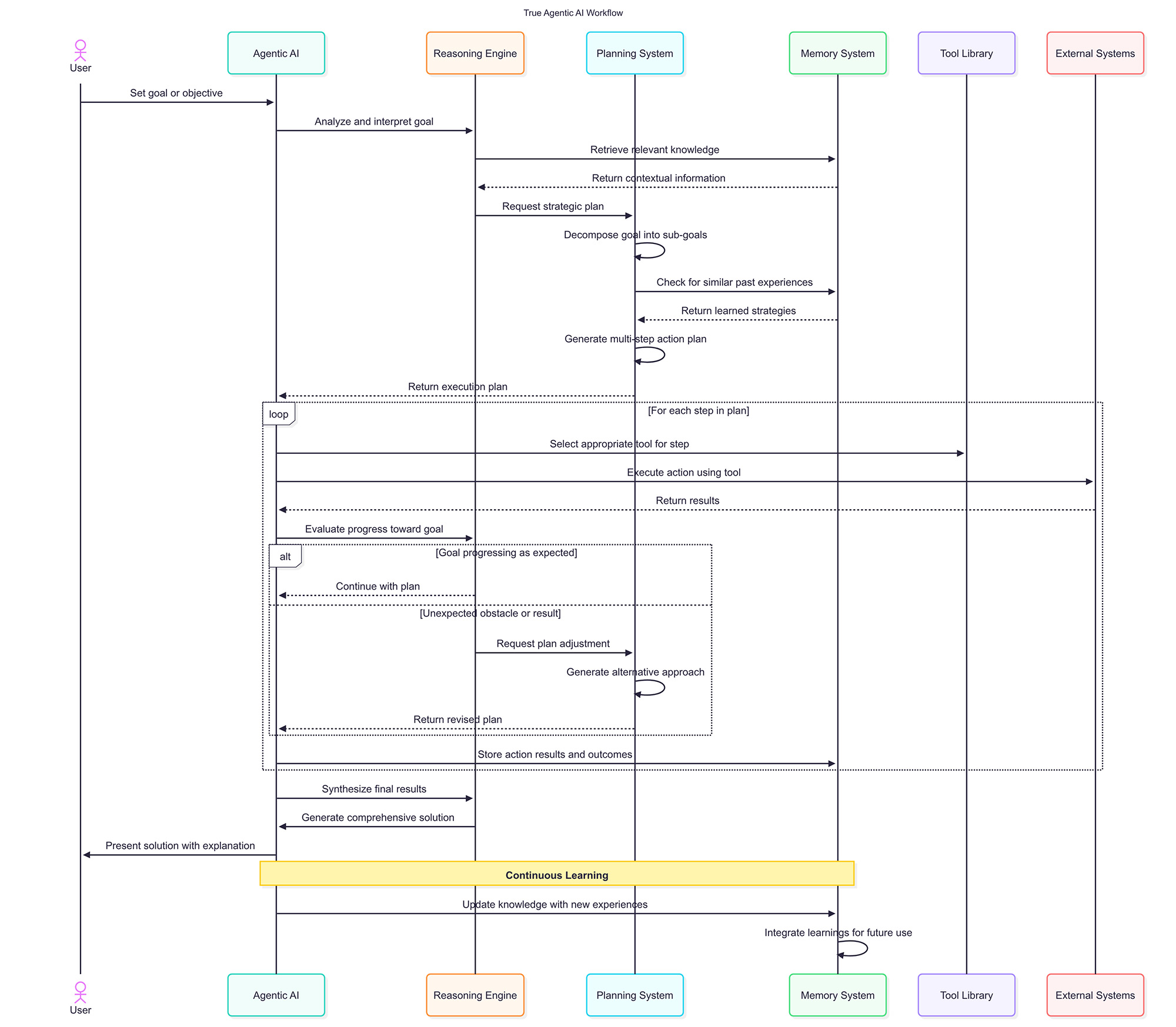
Traditional Agentic AI (see diagram below) attempts to replicate human-like reasoning with complex planning systems, goal decomposition, and continuous strategic adjustments. Notice the multiple feedback loops, reasoning engines, and decision points—this is where the “illusion of thinking” creates complexity without reliability whilst multiplying across your enterprise in ungovernable ways.
Workato’s Orchestrative Approach (see diagram below) focuses on what AI does well: understanding user intent and selecting appropriate pre-built workflows. The flow is linear, auditable, and deterministic once the recipe is selected. Most importantly, it maintains enterprise architectural coherence by keeping business logic centralised and AI distributed.
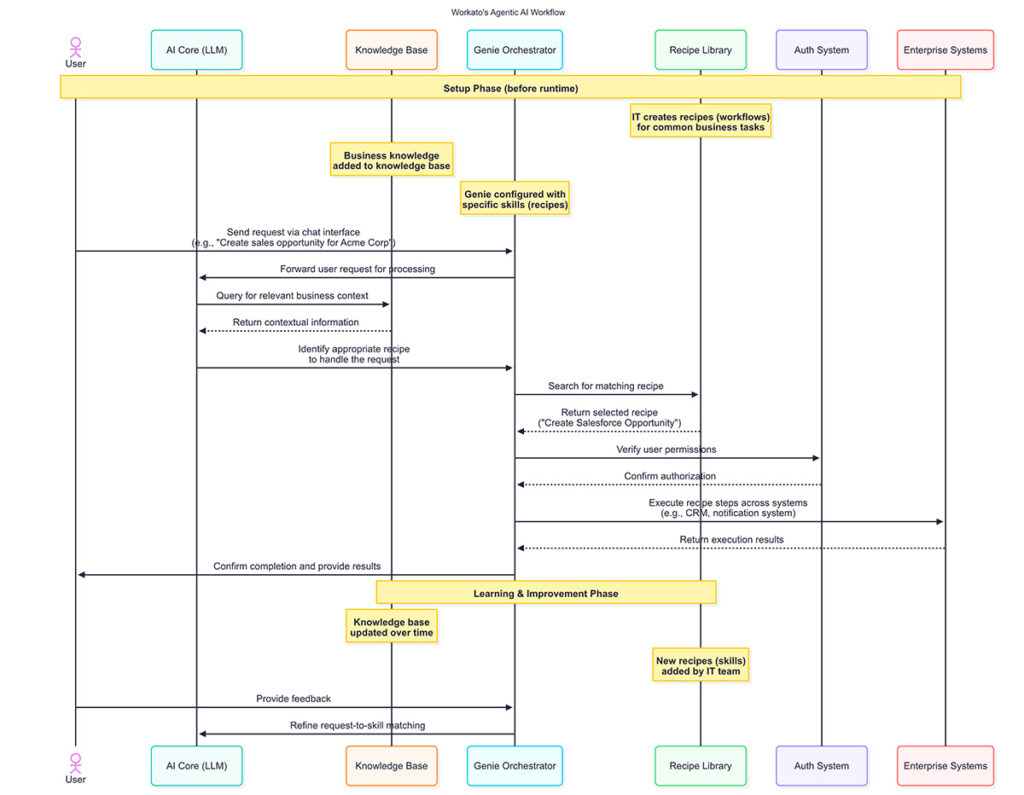
The business implications are stark: one approach promises sophisticated reasoning but delivers unpredictable results and architectural chaos, whilst the other delivers immediate, reliable automation that scales with your business processes whilst preserving enterprise governance.
Real Success Stories: Orchestration Without Chaos
The practical benefits become clear across different business functions:
Customer Service: Workato Genies understand customer requests and trigger appropriate support workflows—updating account information, processing refunds, or escalating to specialists. The business logic for each action is consistent across all touchpoints, preventing the discount confusion scenario.
Sales Operations: Genies interpret sales team requests and execute pre-built workflows for opportunity creation, lead qualification, or quote generation. Pricing rules are maintained centrally and applied consistently, eliminating the chaos of multiple AI agents quoting different prices.
IT Operations: Genies understand problem descriptions and trigger appropriate diagnostic and remediation workflows, delivering faster resolution times with consistent security policies enforced across all AI interactions.
In each case, AI handles what it does best whilst leaving critical business logic to proven, deterministic processes that can be audited, governed, and maintained centrally.

The Framework for AI Success and Architectural Sanity
To implement AI effectively whilst maintaining enterprise coherence, ask these key questions:
What are you asking AI to do? Understanding human intent and orchestrating existing processes represents AI’s sweet spot. Reasoning through novel problems creates both reliability issues and architectural chaos.
Where does your business logic live? In auditable, centralised systems creates maintainable consistency. Embedded in AI prompts across multiple agents creates ungovernable chaos.
How will you verify AI decisions? Pattern matching against known scenarios provides auditable decision-making. Open-ended reasoning distributed across agents becomes impossible to verify.
What happens when you need to change a business rule? Update once in the central system maintains enterprise coherence. Updating across dozens of AI implementations creates architectural nightmares.
Building on AI’s Real Strengths While Maintaining Enterprise Architecture
Smart AI implementations focus on making existing processes more accessible through natural language interfaces, reducing cognitive load through intelligent workflow selection, and democratising automation for non-technical users whilst maintaining human control over critical business logic and preserving enterprise architectural coherence.
This approach delivers immediate value whilst building a foundation for future AI advances. As capabilities evolve, the infrastructure remains valuable—you’re adding more sophisticated understanding to proven business processes whilst preventing the AI Wild West that makes enterprises ungovernable.
The Practical Path Forward
AI is genuinely transformative technology, but transformation comes from applying it correctly, not from expecting it to replace human thinking or scatter business logic across dozens of autonomous agents. The companies seeing real AI ROI today are those that enhance human capabilities whilst maintaining enterprise coherence.
Workato’s success demonstrates this approach in practice. They’ve built AI that makes complex enterprise processes as easy as having a conversation, whilst maintaining the reliability, governance, and audibility that enterprises require. Most importantly, they’ve done it in a way that strengthens rather than undermines enterprise architecture.
The lesson isn’t to avoid AI—it’s to use AI for what it’s actually good at, in ways that enhance rather than destroy your enterprise architecture. Stop asking AI to think, start asking it to orchestrate, and do it through patterns that keep your enterprise governable.
Ready to explore how orchestrative AI can transform your enterprise processes without creating architectural chaos? The conversation starts with understanding what AI can really do—and how to do it responsibly.
Ready to Transform Your Integration Strategy?
Don’t let integration challenges hold your business back. At Cloudorizon, we’ve helped organisations move from fragmented, costly approaches to streamlined automation that delivers real business value.
🚀 Next Steps:
- Book a free strategy session – 30 minutes to identify your biggest wins
About Cloudorizon: We’re Workato specialists who understand that successful integration isn’t just about technology – it’s about connecting business possibilities. With 54+ enterprise clients and proven methodologies, we help organisations build integration capabilities that scale.
Questions about this article? Get in touch – we’d love to hear from you.